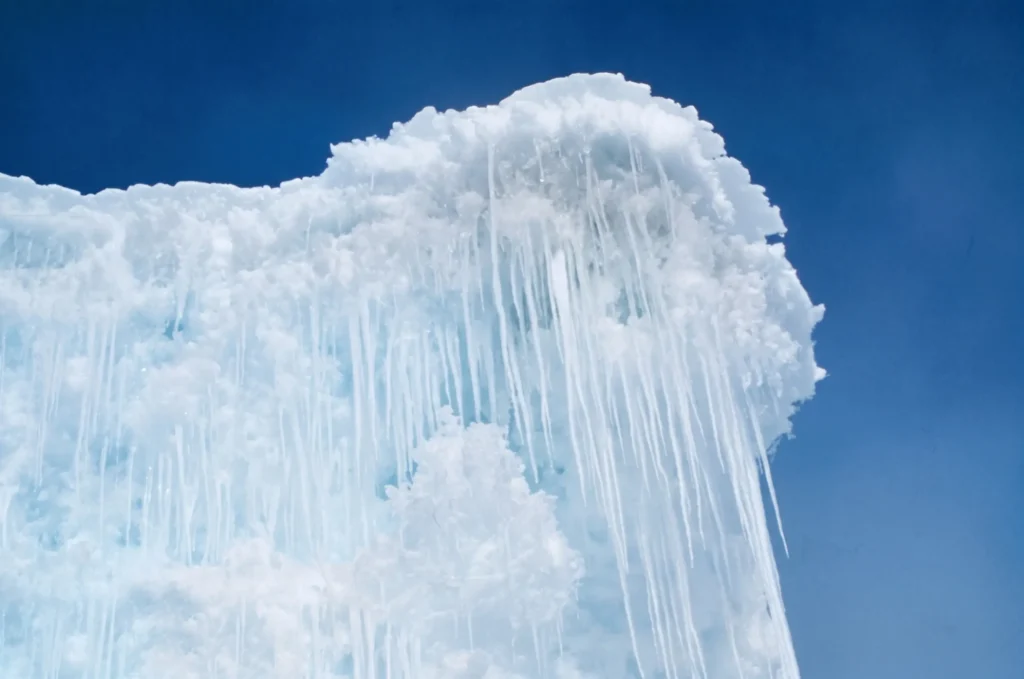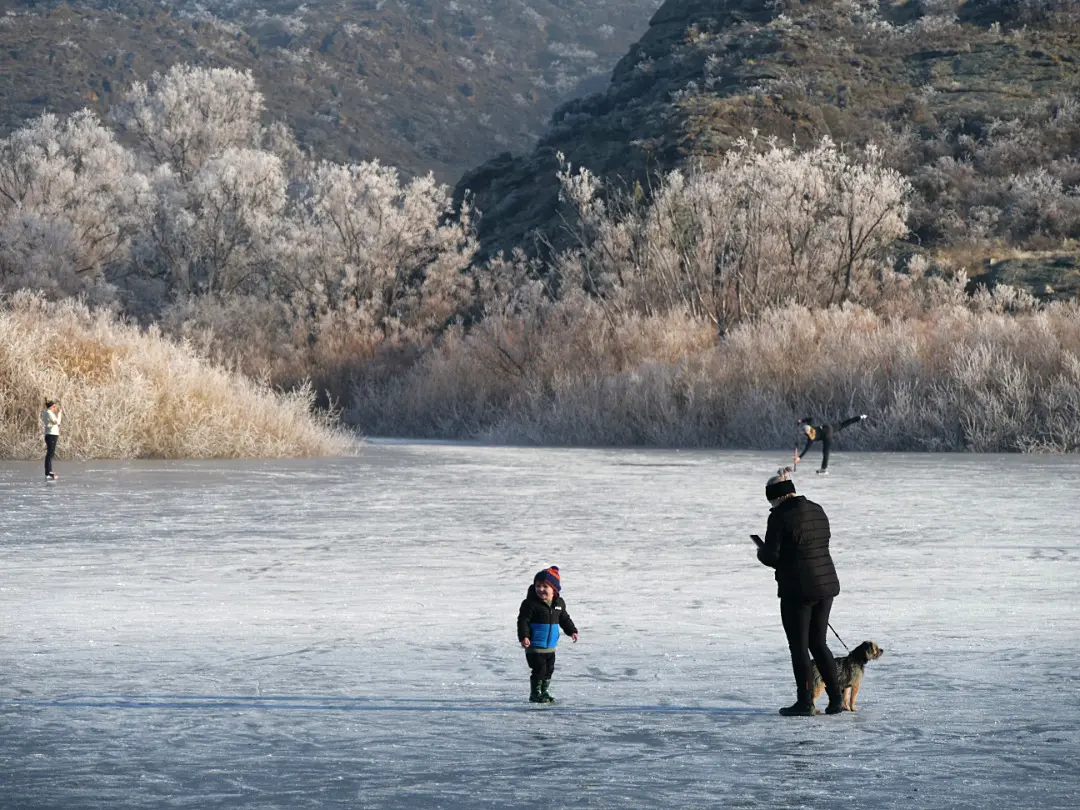
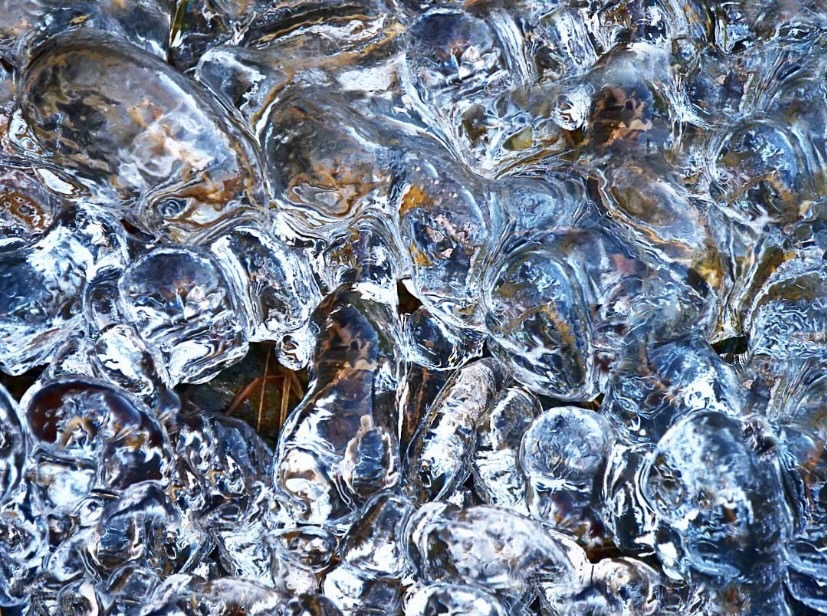
By a spring on the lower Pisa Range. Cardrona Valley near Wānaka.
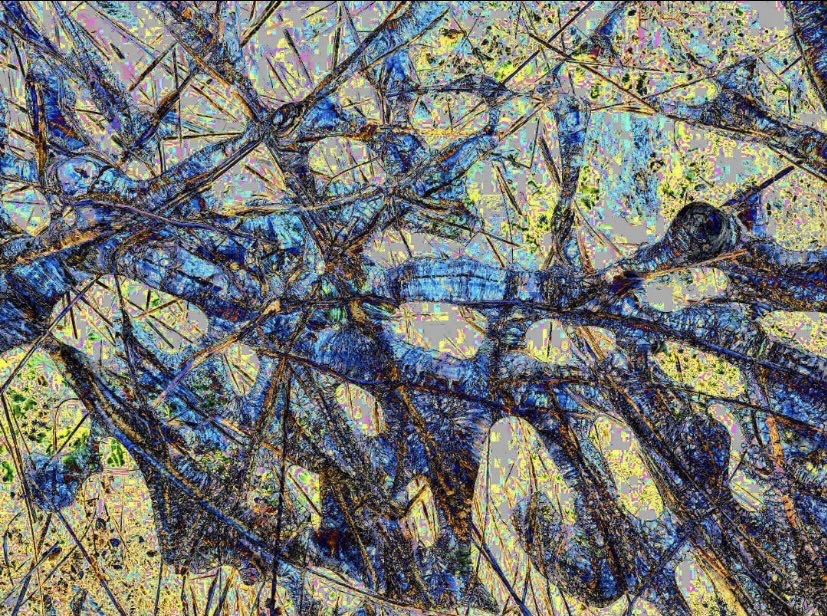
Photo Quest’s focusing on the physical wonder of water and ice, bridging the mountain reality with the artistic abstraction.
The Strange, Generous Alchemy of Ice
We tend to think of ice as merely frozen water—a static, passive state of cold. But look closely enough at its architecture, and you realize it is one of the most eccentric, rebellious substances in the natural world.
Almost every liquid on Earth contracts as it cools, packing its molecules tighter and tighter, becoming heavier and denser until it sinks. Water plays by entirely different rules.
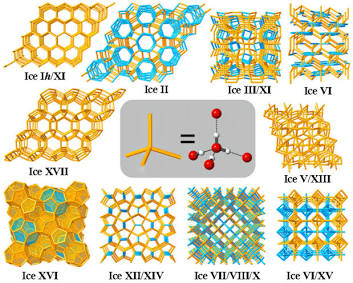
As it cools toward freezing, its hydrogen bonds perform a quiet, improbable dance. Instead of crowding together, they lock into an open, six-sided crystalline lattice (Ice $I_h$). This framework actually holds the molecules further apart than they were in liquid form. Water expands as it freezes. It becomes lighter, less dense, and floats.
If it didn’t—if ice sank to the bottom of rivers, lakes, and oceans—our world would freeze from the seabed up, turning the planet into an uninhabitable block of solid rock. Life exists because ice insists on floating to the top, forming an insulating blanket that shelters the liquid world beneath.
                  THE ANOMALY OF ICE

  LIQUID WATER                    CRYSTALLINE ICE
  (Molecules closely packed)      (Open hexagonal lattice)

    o  o   o    o                  o --- o --- o
   o  o  o   o                       |       |
    o   o  o   o                   o --- o --- o
   (Denser / Sinks)              (Less Dense / Floats)
The Pressure and the Melt
The strangeness doesn’t stop at density. Ice is one of the few solids that can be melted simply by squeezing it.
Under immense pressure—the kind exerted deep within a high-country glacier—the rigid crystalline lattice is forced to yield. The melting point drops, allowing the ice to deform, flow, and slide over bedrock like slow-motion glass. It carves valleys, moves mountains, and absorbs staggering amounts of energy.
To transform zero-degree ice into zero-degree liquid water requires a tremendous burst of energy—its latent heat of fusion. It takes as much energy to melt a block of ice as it does to heat that same water from freezing all the way to 80°C. This massive thermal inertia is what stabilizes our alpine climates, slowing down the thaw and giving life time to adapt.
Abstracting the Invisible
When you point a lens at ice, you aren’t just photographing a surface; you are photographing time, stress, and light trapped inside a matrix.
Applying digital filters or shifting contrast in post-production isn’t about distorting reality—it’s about stripping away the familiar surface reflections to reveal the internal forces at play. It highlights the stress fractures, the trapped air pockets, and the refractive geometry that would otherwise pass unnoticed.
In its natural form or through an abstract lens, ice reminds us that the most ordinary substances around us are often held together by the most extraordinary physics.