
or nostalgia may not be what it used to be!
Black and White… A Return to Clarity

Artistic photos are made when we stop thinking literally about our subjects, and black and white photography, by its very nature, forces us to do exactly that.
Because we see the world in colour, removing it pushes an image into a more abstract space. This essential process compels us to look at light, shadow, and form in a completely different way.
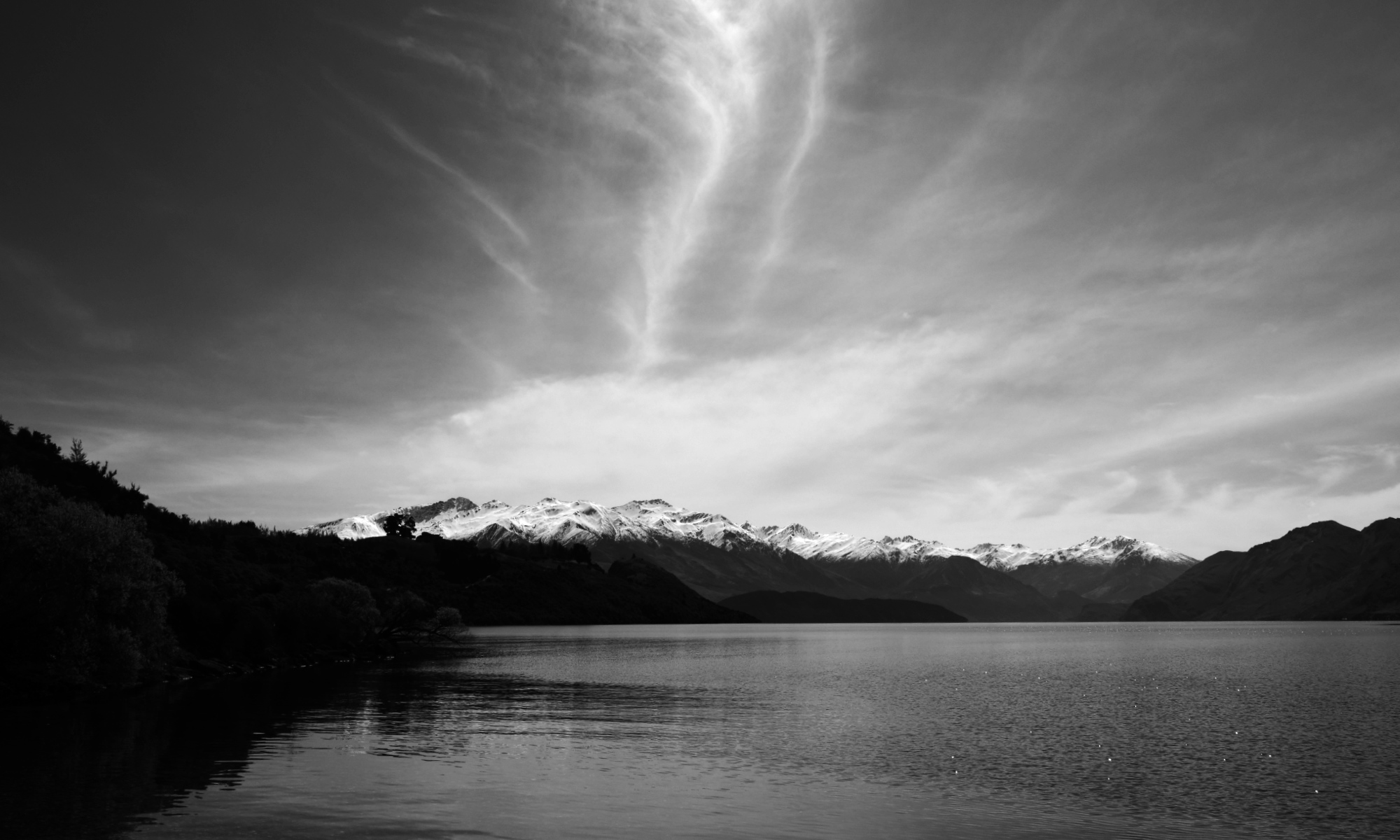
Black and white images possess an artistic and mysterious quality. They thrive on contrast and intrigue, and somehow exist outside of time and space. I especially love making these photos when conditions are moody—like when fog settles in, or when there is harsh contrast between shadow and light—conditions that often don’t lend themselves well to vibrant colour renditions.
## The Moment of Clarity
While walking yesterday along the track above **Lake Wānaka**, heading towards Glendhu Bay, I was struck by the stillness of the mid-afternoon. The light was harsh, yet the water’s surface was gentle. That combination of extremes—of stark contrast and quiet reflection—immediately led me to consider a **black and white image**.

After clicking the shutter, the thought hit me: “I’ve spent a year focused on colour, working toward the imagery for my 2026 calendar—why not challenge myself now? Why not push into a new creative space?”
I realised that shooting exclusively in B&W would achieve two things: it would drastically **reduce the post-processing time** on the computer by removing the colour element, and more importantly, it would force me to be obsessive about **composition and light**.
After all, isn’t that what my very first camera taught me?
## Back to the Beginning: The Folding Brownie
It all began for me with an **Eastman Kodak Folding Brownie Six-20**. Though it was a long time ago, I still remember that this camera was the ultimate teacher of simplicity.

Folding Brownie Six-2
Produced between 1937 and 1940, it was an elegantly basic machine. With a **fixed-focus Meniscus lens** and a rudimentary Kodette II shutter, it gave the photographer very few options for aperture or shutter speed—if any. (A *Brilliant finder* was even an optional extra from 1938!)
And of course it was easy to carry. Even today my “go to camera” was chosen for this reason.
## From the Beginning Onward: Two B&W Lessons
While preparing my thoughts for this post, two images from my past came to mind immediately. Sure, I made hundreds with my old Kodak, but these two still give me much satisfaction. Let’s examine why:
1. Mood over Mechanics: Lake Ohau
The first is of a wild nor’wester storm on Lake Ōhau . I’m still amazed I managed to keep the horizon near level! In that moment, conscious “thinking” was completely excluded. Instead, I focused purely on framing the mood of the extreme conditions—the furious wind and the dramatic light. It’s a primal image where the energy of the scene takes precedence over the technical details.
2. Simplicity and Timelessness: Naseby
The second is a record of historic gold diggings at Naseby . I love its simplicity in how it illustrates the barrenness—the stark landscape left behind after extraction by water and sluicing. It’s a scene now gone, swallowed by overgrown wilding pines. This image not only captures the essence of that past environment but also quietly proves the durability and timelessness of black and white photography.


Both photos reinforce the idea that removing colour focuses the mind on the true essentials: texture, light, contrast, and emotion. It’s time for me to lean into that clarity again!
## The Art of Conversion: Beyond Colour
Converting photographs to black and white forces us to pay acute attention to four essential elements: **tone, contrast, mood, and composition**. While this may feel like a lot to juggle mentally, it becomes intuitive with practice.
A key challenge is that visual elements which appear distinct in colour may sometimes merge in tonality when that colour is removed. As a result, images that look superb in colour can fall completely flat in B\&W, and vice versa.
The secret lies in understanding the difference in how they use light:
* **Colour photography** often thrives in soft light or requires vibrant hues to succeed.
* **Black and white photography** frequently excels in harsh light, where strong contrast between shadow and highlight gives the image its emotional depth and structure.
Understanding these differences is crucial; it helps us identify scenes that are born to be seen without colour, creating a B&W photo with real emotional punch.
### Applying the Rule: Modern Conversions
I recently revisited some of my work—including a scanned colour slide and several digital images—and found a few that converted exceptionally well. These examples perfectly illustrate how the **removal of colour can refocus attention on the subject’s essence**, especially when photographing people.
## Emphasizing Timelessness and Scale
Snow-covered mountains and glaciers are ideal B&W subjects because they transcend time. The monochrome medium elevates the sense of scale and permanence, stripping the scene down to its essential, elemental forms.

When photographing people, black and white truly shines. It immediately strips away the distraction of skin tone and clothing colour, forcing the viewer to focus on the subject’s expression, posture, and the relationship between light and shadow. Backlighting, in particular, becomes a powerful B&W tool; instead of merely blowing out details, it creates dramatic rim lighting and depth, etching the figure against the background and emphasizing the emotional contours of the face. The result is often an intimate and timeless portrait that colour can rarely match.


A new day.
This final image, captured in the cool hush of early winter, perfectly encapsulates the emotional punch of black and white. It’s a southern beech tree filling the frame, defined by the instant the rising sun just crests the mountain ridge.
It’s in moments like this that I feel deeply connected to the mystery of a new day. There’s a profound sense of anticipation, of knowing I’m about to be warmed and enveloped by the unfolding experience. The monochrome medium allows the raw and primal power of dawn light to dominate.
I am dedicating the coming months to capturing the world exclusively in light, shadow, and tone—a return to the clarity and basics taught by my old Folding Brownie. This isn’t just a technical exercise; it’s a quest for simplicity and the emotional depth that only monochrome can provide.
Join Me on This Journey
This pivot in my personal work happens just as my latest annual project is complete. My 2026 Calendar—filled with the vibrant colour work that defined my last year—is now listed and on sale in my newly rebuilt web shop.
It’s the perfect contrast to this new artistic quest, and the ideal way to support the continued work I do here at PhotoQuest.
Click below to secure your copy:


